Fight Week & Post-Fight Weight Cut Guide
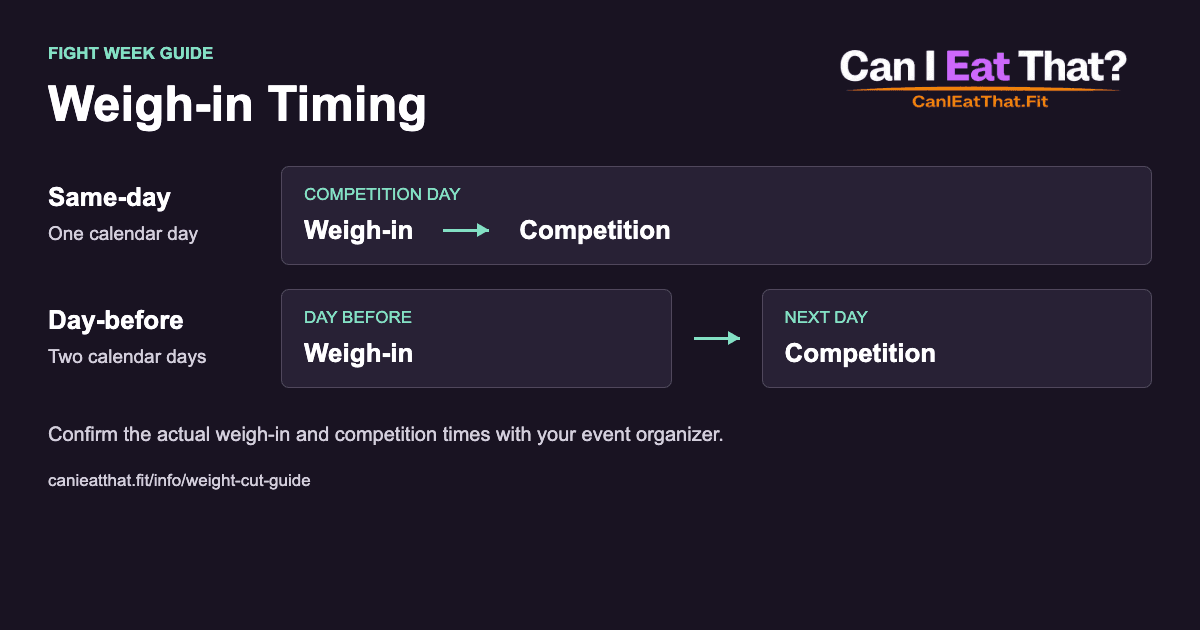
This page outlines what to expect during fight week and immediately after competition. Two weigh-in styles are referenced throughout: day-before and same-day.
Follow any protocol at your own discretion and under the guidance of a trained medical professional. This information works best when the weeks before your cut include heat acclimation practice and a diet that has been intentionally planned around fiber, carbohydrates, sodium, training, and recovery.
7 Days Out — Get Organized
- Hydration: Use optimal intake and avoid extremes. A common target is 50 ml/kg of body weight.
- Nutrition: Keep protein and fats steady. For day-before weigh-ins, begin light carbohydrate restriction. For same-day weigh-ins, start swapping high gut-residue foods for low gut-residue foods such as white rice instead of brown rice or refined bread instead of whole grain.
- Training: Use a normal taper with no last-minute intense sessions.
- Checklist: Gather weigh-in essentials: towels, scale, wrap or sauna suit, familiar refuel foods, and hypotonic oral rehydration solution.
6 Days Out — Keep Cruise Control
- Hydration & Nutrition: Keep the same structure as 7 days out.
- Training: Focus on recovery and sleep quality.
5 Days Out — Consistency
- Hydration & Nutrition: Keep the same approach as 7-6 days out.
- Logistics: Confirm weigh-in time, travel, and accommodations.
4 Days Out — Sodium Taper & Water Load
- Hydration: Begin water load. Aim for 100 ml of water/kg of body weight. Drink up to 1 liter per hour and do not exceed that rate.
- Sodium: Start lowering salt. Do not cut it completely; reduce it. Use about 500 mg of sodium/kg of body weight max.
- Nutrition: Keep the same approach as 7-5 days out.
3 Days Out — Low-Fiber Focus
- Hydration: Continue water load.
- Sodium: Continue sodium taper.
- Fiber: Switch fully to low-residue foods such as white rice, refined carbs, and peeled fruits. Aim for less than 10-15 g of fiber per day.
- Nutrition: Keep the same approach as 7-4 days out.
2 Days Out — Hold the Line
- Hydration: Continue water load.
- Sodium & Fiber: Continue tapering.
- Nutrition: Keep the same approach as 7-4 days out.
- Training: Use only light movement and prioritize rest.
1 Day Out — Precision & Calm
- Hydration: Cut water intake significantly. A common target is about 15 ml/kg of body weight over the 24 hours before weigh-in; after that, use small sips only for comfort.
- Sodium: Less than 500 mg/kg of body weight.
- Fiber: Extremely low, easy-to-digest meals only. Keep fiber below 10-15 g/day.
- Food timing: Finish the last full meal about 24 hours before the scale. Keep it high protein/fat and low carb/fiber.
- Induced sweating protocol, day-before only: Do this only under the supervision of a trained medical professional. Mix active and passive sweating the evening before weigh-in, do not lose more than half of your remaining weight, and do not expose yourself to high heat for longer than 20 minutes at a time.
- Prepare: Tub access, towels, thermometer, sauna suit, thick blanket, oral rehydration solutions, and an accurate scale.
Weigh-In Day — Final Push
- Before the scale, use only small sips of water and avoid prolonged heat.
- Induced sweating: For day-before weigh-ins, a supervised bath-and-wrap method may be used. For same-day weigh-ins, use only gentle aerobic warm-up such as a stationary bike or standard warm-up exercises.
- Bath: 99-107.5°F until a consistent sweat interval is observed.
- Duration: Once consistent, stay in the bath no more than 20 minutes.
- Exit: Leave slowly and dry off low to the ground.
- Wrap: Sauna suit plus towels or blanket. Once sweating is consistent again, stay no more than 40 minutes.
- Break: Rest 20-30 minutes, weigh, and repeat only as needed.
- Safety: Stop immediately for rapid pulse, palpitations, dizziness, shortness of breath, or light-headedness.
- Cooling: Use lukewarm water only. Do not use cold plunges.
After Weigh-In — Refuel Framework
- Replace fluids gradually with hypotonic solutions, about 1.5 L per liter lost. Do not exceed 1 liter per hour.
- Carbohydrates: mild cut about 4-5 g/kg, moderate cut about 6-7 g/kg, aggressive cut about 8-10 g/kg.
- Use familiar high-GI, low-fat, low-fiber foods. Add about 20 g of creatine if you are a habitual user.
- Finish the last meal about 3 hours before bed for calm digestion.
Fight Day — Execute
- Fuel with carbs around 4-5 g/kg, protein about 2 g/kg, fat about 0.5 g/kg, and low fiber. Creatine about 20 g if you are a habitual user.
- Timing: last full meal about 4 hours before warm-up; fast carbs about 45 minutes before walk-out.
- Use familiar foods only. Nothing new on fight day.
Post-Fight — Reverse Diet & Recovery
- Gradual regain: increase calories no more than 10% per week and aim for no more than 2 lb/week weight regain.
- Use a simple rule: 80% of the time, eat healthy meals; 20% of the time, do not worry about it.
- Keep structure with the same eating rhythm and slightly less precision.
- For concussion recovery, focus on omega-3s, colorful foods, sleep, no alcohol, and high creatine intake.
References
- Making Weight: The Ultimate Science-Based Guide to Cutting Weight for Combat Sports, Jordan Sullivan and Danny Lennon, Sigma Nutrition Publishing, 2023.